There’s no place like home, they say. And even if one’s home were no haven, it’s where most people spend the bulk of their lives — building their own realities behind closed doors, away from society’s gaze. It’s where family cultures are born, where meals are shared, where things are said that would never be said in public. Some decorate their homes to match society’s expectations, others treat them as mere places to sleep. Whatever the case, one thing is for sure: homes are a reflection of the society around them.
From cars to strange homes
I’ve always been somewhat a homebody, so it’s perhaps only logical that I also love to stay in strangers’ homes. Yet, my love for seeing cultures from the inside didn’t start through homes. It started through cars. On an unplanned hitchhiking trip across Europe nearly three decades ago, I realized that being in people’s own space gave them the liberty to express themselves more freely than when in public. Random cars were a great gateway into cultures: hours of uninterrupted conversations with drivers who had nothing else to do but talk. So, I saw landscapes whilst at the same time hearing intriguing life stories, recounts of local history or small yet meaningful cultural anecdotes. Homes came later.
Bicycle travel makes homes accessible
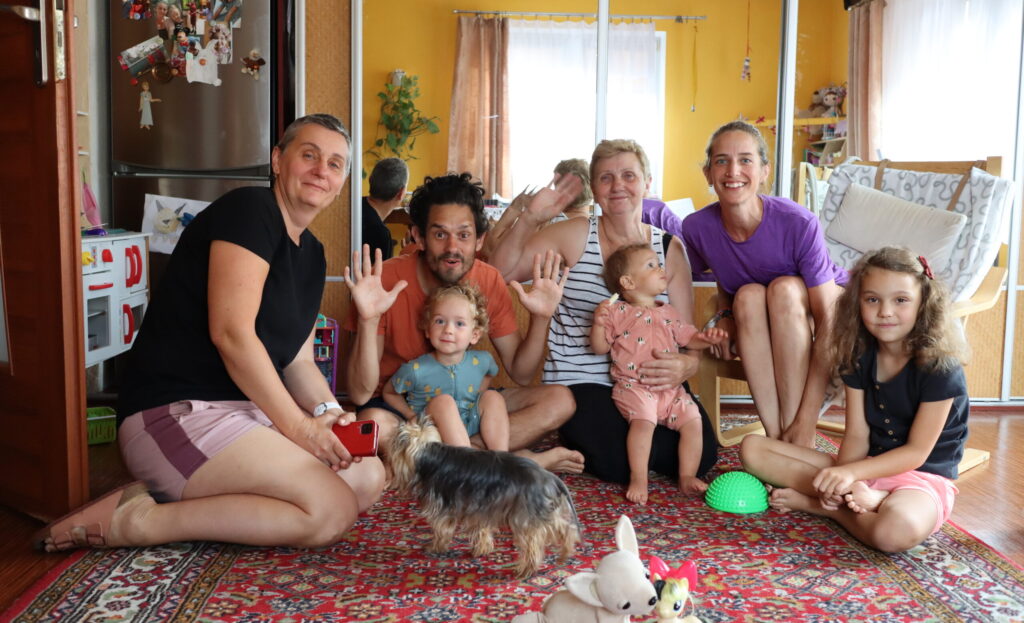
To me, bicycle travel is a natural continuation of hitchhiking. It makes local homes accessible in a way that most travel doesn’t. Of course, you can visit homes through platforms like Couchsurfing or Workaway, but those platforms work like a catalogue: you select your host and arrive at a curated experience. Bicycle travel, on the other hand, has no catalogue. You look, you approach and you speak to people — like in the good old days. And crucially, you end up in a far wider cross-section of society. In many parts of the world, Couchsurfing, also skews heavily toward educated, upper-middle-class hosts, which by no means represent the whole society. On a bicycle, you knock on doors spontaneously and wait.
Social and cultural data behind closed doors
What you find behind those doors is an endless well of cultural data. It’s anthropology served to you on a plate — like Dollar Street, but instead of looking at photos you’re inside those photos. You see when and how people brush their teeth, what they put on the table, how parents speak to children, how couples move around each other in a kitchen. But that’s not always comfortable. I’ve sat in homes where women were spoken to like they were nothing. And as the most extreme example, I’ve seen children and women scream of fear in a case of domestic violence. As I say, homes are not always havens.
But homes are where the smallest unit of society — families — live and they reflect societies faithfully. The decorational choices, the presence or absence of running water, whether eating meat is out of necessity or a considered decision, what toys children are given and how they play with them — these all of point toward something larger. However, the interior design matters less than the interior life. The conversations at the dinner table, the silences, the way family members treat each other… Those are what opens up the culture and the society in a subtle way.
Homeschooling through homes
As we prepare to leave our home in Spain and set off to bicycle through Italy, the Balkans and beyond, I think of what lies ahead not only as travel or work, but also as an opportunity for homeschooling in the most literal sense. Not keeping children at home for domestic education, but letting them learn through homes. Through the families who open their doors to a strange Finnish-Brazilian family who arrived on bicycles. And through the societies those homes quietly and faithfully reflect.
Hotels, restaurants and tourist districts smooth create the illusion that cultures can be consumed without ever entering the private worlds where they are actually formed. But at home, values become habits. That’s where fears, aspirations, hierarchies and affections show up. And if you manage to enter home, you’re literally an insider, not an outsider, anymore.
What can kids learn through homes?
People construct lives within the constraints and possibilities they inherit. Homes may be small, ordinary places, but taken together they form the emotional architecture of entire civilizations. And child who grows up seeing many homes grows up seeing many versions of what is considered normal. One family eats together in silence, one says a prayer before each mean, another debates loudly for hours. One locks every gate, another leaves the front door open all day. One measures wealth in possessions, another in guests.
Very soon, we’ll be taking our kids out of school in order to travel with them. We’ll be cutting off the social ties they’re formed within the past year, we won’t be guided by a school curriculum anymore and we’ll basically be 100% responsible for their education. It’s a privilege but also very daunting. Are we doing everything wrong? Are we crazy? Would the kids be better off in school? As much as I don’t have answers to these questions I want to believe that we’re offering our kids an invaluable experience, an unforgettable adventure and the vastest education we could ever image: homeschooling in its most literal meaning.
Getting ready for homeschooling
We’re currently studying legislations, curricula and methodologies while getting ready for homeschooling / worldschooling / bikeschooling our children. It’s not a streamlined path, as we soon won’t officially have residency in any country anymore, and thus no country will provide us with educational guidelines or guidance after leaving Spain. It’s a battle, but also extremely interesting to take on such a responsibility, guided by the mission to show our children the world. If this is something that you’re interested in, I will be writing more articles on it as the process unwinds. So, stay tuned!