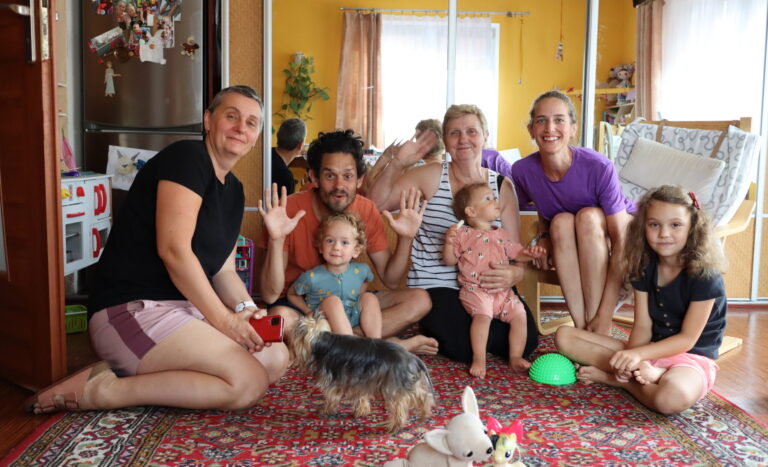
Many multilingual kids mix up languages all the time. So do my quadrilingual children, and not just from time to time, but basically all the time. Yet, research says code-switching is a skill, not a deficit. So why does it happen and what to do about it?
Should you be worried?
“Mom, are we going on the viagem de bike (Portuguese for “bicycle tour”) soon, I’m aburrido (Spanish for “bored”).
Lovely little sentence, right? I’ve translated it so you get the gist: a child mixing up two or more languages in one sentence. Should we as parents be worried?
Short answer, no.
…If you continuously support your children’s language learning, that is.
Our quadrilingual reality
My kids were born in Finland and for the first few years Finnish was their strongest language. Then, we went on a few bicycle tours, and eventually moved to Spain — for some time. Now, our quadrilingual everyday is as follows: our family language is Portuguese, I speak Finnish with my kids, their father Portuguese (the “one parent, one language” method), their school language is Catalan and with their friends, they speak Spanish. On top of that we regularly receive cyclists through Warmshowers who’ve introduced them to e.g. French, German and English.
Nowadays our kids rarely say a sentence in one language, but rather mix up at least two, sometimes more languages. In. One. Single. Sentence. Truth be told, I used to freak out about this. I didn’t know what to do as they were clearly losing something I’m extremely passionate about: language. Thus, I wondered whether we should move back to Finland for them to speak properly. Or whether I should force them speak in monolingual sentences. Or whether we should officially change our home language to Finnish when not in Finland.
And that’s when I was reminded about code-switching by a fellow plurilinguist.
What is code-switching?
In linguistics, languages are considered complex, rule-governed systems comprised of phonology (sounds), morphology (word structure), syntax (sentence structure), semantics (meaning) and pragmatics (use in context). They’re not just vocabulary, and they’re not just grammar, but a combination of all of these elements. When you know a linguistic code, you know how to form words, how to form sentences and when and where to use those sentences. It’s not about necessarily knowing specific words, but rather about cracking complex codes.
As Ludwig Wittgenstein would put it:
“The meaning of a word is its use in the language.”
And when you crack a linguistic code, you understand how to create meanings with words.
Code-switching, on the other hand, is when you use two or more of linguistic codes interchangeably. It’s knowing what a word or expression means in a linguistic context and using it in another linguistic context either because (1) the same kind of expression doesn’t exist in the language you’re currently speaking or because (2) it’s simply easier. It’s like navigating to a place you know without using a map. You know the area and all possible routes leading to your destination by heart, and thus you can choose the easiest, fastest or safest way to get there.
Code-switching in cultural context
I’ll give you an example of code-switching in my home country: In Finland, a minority of Finns speak Swedish as their mother tongue. Swedish-speaking Finns usually know Finnish, even though they may not actively speak it. In this bilingual reality, Swedish-speaking Finns still often use Finnish words and expressions, even when speaking with other Swedish-speaking Finns. Not because they don’t know the Swedish equivalent or their language skills are somehow hollow. But quite the opposite: they consciously choose words and expressions from various linguistic codes to best match what they want to express.
The same goes for bi- or multilingual children. It’s not necessarily that they don’t know how to express themselves monolingually, but they strategically or intuitively choose to express themselves in a certain way — just because they can. What’s huge is that even young children switch languages systematically, respecting complex linguistic codes!
However, kids may also lack active vocabulary in a language and there’s nothing unusual about it. In the end, we all use way less words in our everyday speech than what we actually know. This is true to our mother tongue (think about the words you understand when reading a novel vs the words you actually use in your daily life), and it’s also true to the foreign languages we speak — words and expressions easily become dormant when you don’t use a language. Yet if you’ve mastered a code once, you’re likely able to pick it up again, especially if there’s continued exposure.
Supporting your child linguistically
So, how to support your child’s language learning in a bi- or multicultural environment? First of all, don’t worry if your child prefers one language or another at some point in their lives, especially if it’s a minority language in an immigration setting. It’s normal. Don’t force your child to speak your language. If they have receptive fluency in a language, it’s already a great start. They may refuse to speak a language or go through silent phases, but if exposure continues, they’ll pick it up eventually — if they want to. As children grow, they naturally learn when mixing is appropriate and when it isn’t.
For more posts on linguistics, see e.g. SOCIOCULTURAL LINGUISTICS: A WORLD SHAPED BY LANGUAGES or STAR WARS GO LATIN: “USE THE ONDA!”.
Easy steps to take
Although there’s probably nothing to worry about even though your child mixes up languages, there are some easy steps you can take to reinforce their language skills, also while traveling.
This is what you can start doing today:
- Speak to your child (heureka!)
- Read for and with them
- Engage in conversations
- Sing songs
- Tell stories
- Watch TV in your language (if you watch TV)
- Play
Whatever you do, try to be consistent.
In your everyday, you might end up mixing languages yourself. I know I do, although we try to stick to the “one parent, one language” -method. What matters most is remembering that kids are kids. They rarely learn by being forced into doing something. They learn through interaction, meaningful input and because they want to connect. And what better way to connect than language?
…And yes, we’ll be going on our viagem de bike soon, because our kids are aburridos and that’s our sueño.
For more posts on intercultural encounters in the context of language, look out for my upcoming post on the GRAMMATICAL GENDER AND THE PROBLEM OF TRANSLATION.